Build AI-Native Applications That Change How Work Gets Done
Our AI-Native Application Development Services help enterprises design and build applications where AI, enterprise context, automation, and intelligent workflows are part of the architecture from day one — not features added after the product is built.

More Than AI Added to
an Existing Application
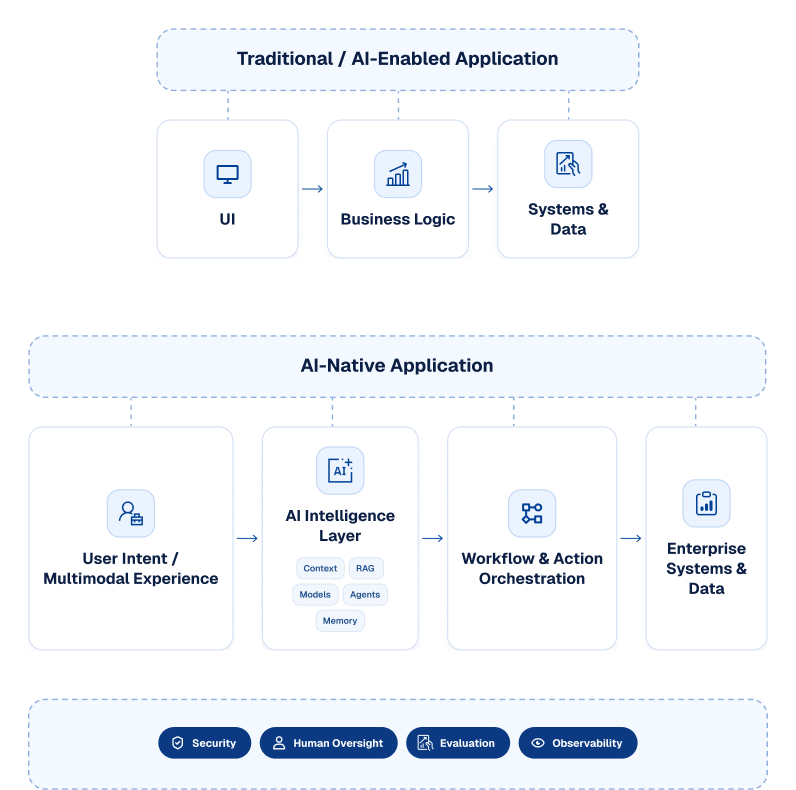
An AI-native application is designed from the outset around intelligence as a core application capability. AI materially shapes how users interact, how workflows execute, how decisions are supported, and how the application creates value.
Unlike an AI-enabled application that adds isolated AI features to an existing interface, an AI-native application brings together AI, enterprise context, business logic, workflows, and connected systems as part of one product architecture.
AI-Native Application Development Services for
Enterprise Innovation
Our Enterprise AI Application Development Services combine product engineering, enterprise AI, data, workflows, and system integration to build applications where intelligence is central to how the product operates and delivers value.

AI-Native Application Strategy & Experience Design
Define the user, workflow, business outcome, and appropriate role for AI before selecting the technology or designing the interface.

AI-Native Application Architecture
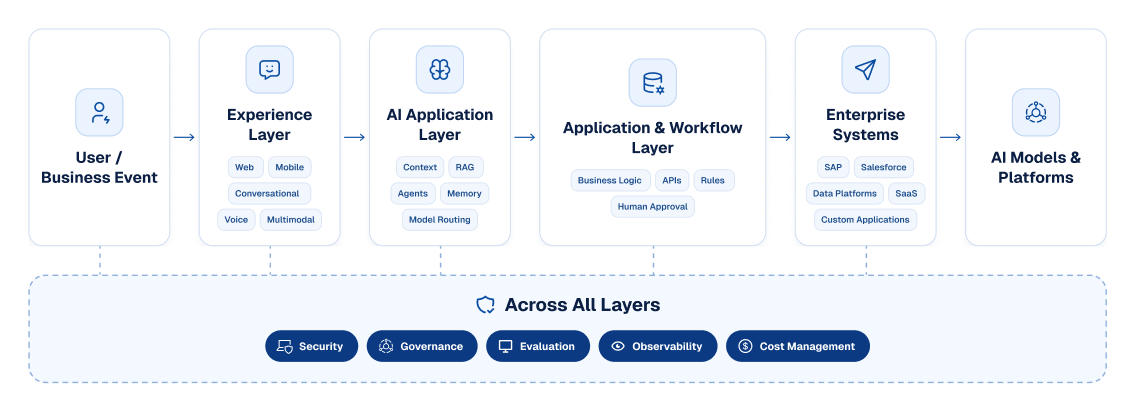
Design the model, context, orchestration, data, security, evaluation, and application layers together so AI can operate reliably inside the product.

Custom AI-Native Application Development
Build applications where AI materially shapes workflows, decisions, and user experiences rather than operating as an isolated feature.

Embedded AI Copilot Development
Build contextual assistance directly into the flow of work for analysis, recommendations, drafting, and decision support.

Agentic Workflow & Action Orchestration
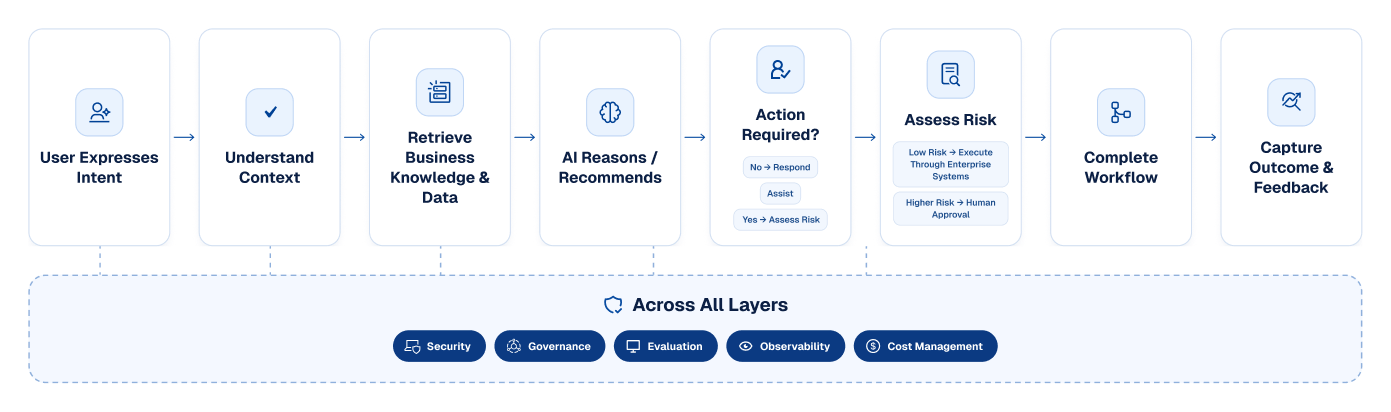
Enable applications to interpret user intent, coordinate AI capabilities, and execute governed actions across connected enterprise systems.

Conversational & Multimodal Application Development
Create coherent application experiences across text, voice, image, documents, and traditional interfaces based on what each task requires.
AI-Native Application Modernisation
Modernize existing applications by augmenting workflows with AI, recomposing selected experiences, or building new AI-native capabilities where they create greater business value.

Build AI Into the Application
Architecture, Not Just the Interface
AI-native applications require intelligence, workflows, enterprise systems, and governance to operate as one architecture.
AI-Powered Application Solutions Built
Around Users and Workflows
AI-Native Applications are judged by whether intelligence materially improves how work gets done, not by how many AI features are visible in the interface.
Context-Aware Application Intelligence
Use the user’s role, current task, application state, workflow context, and authorized enterprise data to provide relevant assistance or determine the next appropriate action.
Role & Context-Aware Personalisation
Tailor assistance using approved user, role, and workflow context while respecting enterprise permissions and data policies.
Human-in-the-Loop Decision Support
AI can recommend, prepare, or act automatically where appropriate, while human approval remains in the workflow for decisions where business risk or judgement requires it.
AI Evaluation & Application Observability
Measure response quality, task completion, latency, failures, safety, and cost so AI behaviour can be monitored and improved after launch.
AI Where It Adds Value. Deterministic Logic Where It Matters.
Combine generative and agentic capabilities with traditional application logic so critical rules, calculations, permissions, and controls remain predictable.
Natural Language User Experiences
Allow users to express intent naturally while retaining structured interfaces where forms, workflows, and controls remain more appropriate.
Multimodal Application Experiences
Combine text, voice, images, documents, and visual interfaces where the workflow benefits from multiple interaction modes.
Model-Flexible AI Architecture
Reduce dependency on any single model provider so new models can be evaluated and adopted without redesigning the entire application.
Feedback-Driven Optimization
Use user feedback, failed interactions, and production signals to continuously improve prompts, retrieval, models, and workflow design.
Turn User Intent Into
Governed Business Action
AI-native applications should do more than generate responses. They should use enterprise context to support decisions and complete workflows safely.
Business Value Delivered Through
AI-Native Applications
We baseline current task completion time, workflow friction, and user effort first so improvement can be measured against real business outcomes.
Faster Task Completion
Reduce navigation, data gathering, and repetitive steps by bringing assistance and automation directly into the workflow.
More Natural User Experiences
Allow users to express intent using language, voice, documents, or images without forcing every interaction through rigid application flows.
Better Decision Support
Surface relevant enterprise context, recommendations, and analysis at the point where users need to make decisions.
Reduced Application Friction
Simplify complex workflows by allowing AI to interpret intent and coordinate the next steps behind the interface.
Faster Process Execution
Move beyond presenting information by helping users complete work across connected enterprise systems.
Continuous Product Improvement
Use production feedback, usage signals, and evaluation data to improve AI behaviour and application performance over time.
Greater AI Reuse
Build reusable AI, data, and orchestration components that can support multiple enterprise applications instead of isolated pilots.
Choose the Right Level of
AI Transformation
Not every existing application needs to be rebuilt. KloudData helps determine the appropriate modernization path based on business value, architecture, and workflow opportunity.
Augment
Embed contextual AI capabilities into an existing application or workflow.
Recompose
Redesign selected workflows around AI, automation, and more natural interaction patterns.
Build AI-Native
Create a new application where AI is central to the architecture, experience, and workflow from day one.
Choose the level of transformation based on business value — not AI novelty.
Why Choose KloudData as Your
AI-Native Application Development Partner
Many AI applications struggle before the model becomes the problem. The wrong workflow, interaction pattern, data foundation, or level of autonomy can undermine the product before it reaches production.
KloudData starts with the user, workflow, and business outcome — then designs the AI, application architecture, enterprise integration, and operating model around what the product actually needs.
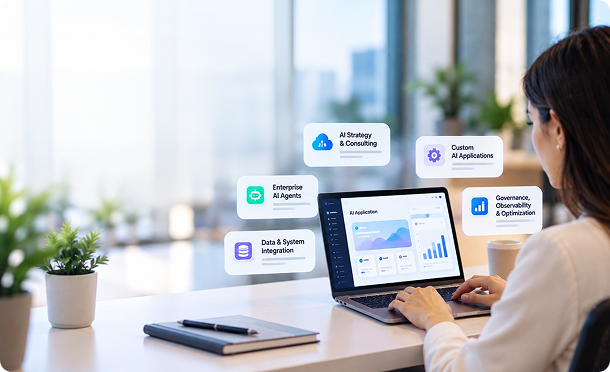


Latest AI-Native Application Insights
Frequently Asked
Questions
What Are AI-Native Application Development Services?
How Is an AI-Native Application Different From an AI-Enabled App?
When Should You Build an Embedded AI Copilot Into an Application?
How Do AI-Native Applications Connect With Enterprise Systems?
Do We Need to Rebuild Our Existing Application?
How Do You Measure AI-Native Application Quality?
Ready to Rethink What Your Application Can Do With AI?
Create intelligent applications that combine AI, enterprise data, business workflows, and human oversight to help users complete work more effectively.
Discuss Your AI-Native Application Use Case