Connect APIs, CRM and ERP. Streamline Business Workflows
Most enterprises run applications that were never designed to work together. The gaps are often filled with manual re-entry, disconnected data, and fragile point-to-point integrations.
Our Enterprise Application Integration Services replace that complexity with governed, reusable connectivity across the applications, systems, and data flows the business depends on.
Enterprise Application Integration Services for
Connected Business Systems
Our Application Integration Services combine enterprise architecture, API engineering, Workato orchestration, CRM and ERP expertise, and legacy connectivity to help systems work together reliably as the business evolves.

Enterprise Integration Strategy & Architecture
Select the right integration pattern — API, event, messaging, batch, or file-based — based on latency, data volume, coupling, reliability, and business criticality.

API Integration Services
Design governed, reusable APIs that reduce bespoke connection logic and create consistent access to business capabilities and data.

Workato Integration & Automation Services
Design and implement Workato recipes, reusable integrations, APIs, and workflow orchestration across CRM, ERP, SaaS, and custom enterprise applications.

CRM Integration Services
Connect Salesforce and other CRM platforms with the applications that create, consume, and act on customer information.

ERP Integration Services
Connect SAP, Oracle, and other ERP platforms while clearly defining system-of-record ownership across customer, order, product, and financial data.

Business Application Integration
Connect finance, HR, service, operations, and SaaS applications through a consistent integration architecture.
Custom & Legacy System Integration
Create purpose-built connectivity for legacy and specialized applications where standard connectors or packaged integrations are not sufficient.
B2B & Partner Integration
Connect suppliers, customers, and external business partners through governed APIs, EDI, and secure data-exchange patterns.

Connect Applications Through a
Governed Integration Layer
Modern enterprise integration is not a collection of point-to-point connections. It is an architecture that allows applications, business events, workflows, and data to move reliably across the enterprise.
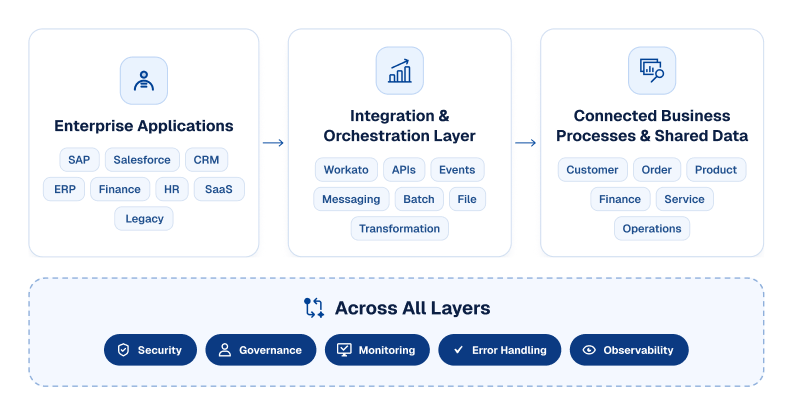
Application Integration Solutions Built for
Reliable Enterprise Connectivity
Our Enterprise Application Integration Solutions use the pattern that fits the systems, business process, and data involved. The goal is not to force every interaction through one technology, but to design connectivity that remains reliable and maintainable over time.
API & Integration Pattern Engineering
Use reusable, governed APIs where synchronous access is appropriate, alongside event, messaging, batch, and file-based patterns where business requirements call for them.
API Management & Governance
Design, secure, publish, version, monitor, and govern APIs so integration assets can be reused safely across applications, teams, and business processes.
Event-Driven Integration
Publish and consume business events so applications can respond asynchronously to changes such as orders, inventory updates, customer activity, or service events without creating tightly coupled dependencies.
Cloud, SaaS & On-Premise Connectivity
Connect hybrid application landscapes through governed integration patterns across cloud, SaaS, legacy, and on-premise environments.
Workato & iPaaS Integration
Use Workato to orchestrate application connectivity, workflow automation, APIs, and cross-system business processes with centralized governance and monitoring.
Real-Time & Near-Real-Time Integration
Propagate critical business changes at the speed the process requires using APIs, events, and messaging without unnecessarily duplicating data across systems.
Data Mapping & Transformation
Map and transform fields, objects, and business structures between applications with different data models and ownership rules.
Integration Monitoring & Transaction Traceability
Detect failures early, automatically retry recoverable transactions, trace business transactions across systems, and route exceptions with enough context for rapid resolution.
One Integration Architecture.
Different Patterns for Different Requirements.
The right integration pattern depends on how the business interaction needs to behave.
Immediate Request / Response
API — For synchronous access, validations, queries, and create/update operations.
Respond When Something Changes
Event — For loosely coupled systems that need to react to business events.
Reliable Asynchronous Processing
Messaging / Queue — For durable processing, retries, workload decoupling, and high-reliability transactions.
Scheduled or High-Volume Movement
Batch / File — For bulk data movement where real-time interaction is not required.
External Partner Transactions
B2B / EDI — For governed supplier, customer, and partner exchanges.
Use the right integration pattern for the right business interaction.
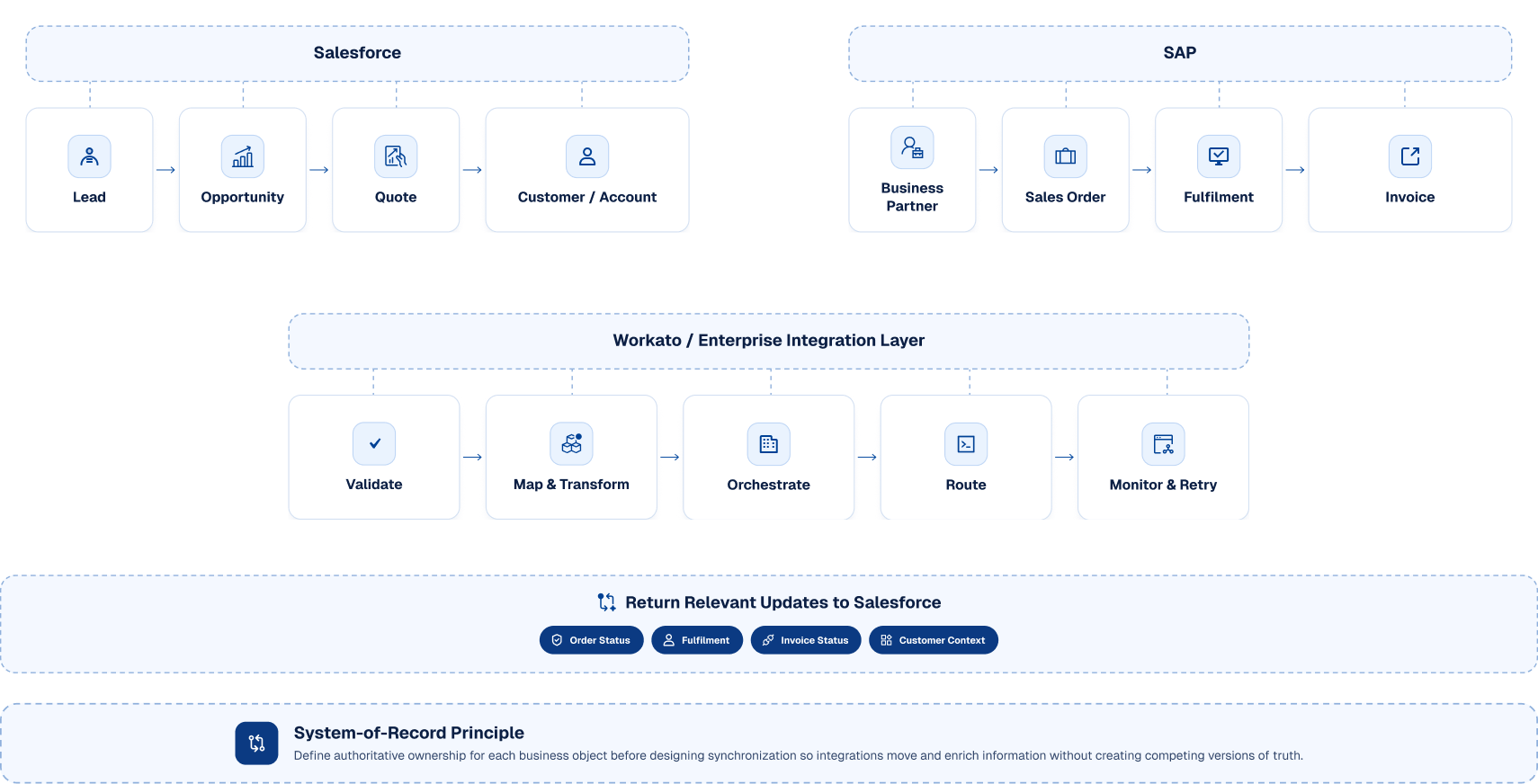
Connect Front-Office and
Back-Office Processes End to End
KloudData combines Salesforce, Workato, and SAP expertise to connect customer-facing processes with order, fulfillment, and financial operations.
Business Value Delivered Through
Enterprise Integration
We baseline current manual effort, data inconsistencies, process delays, and integration failures first so improvement can be measured against actual business operations.
Reduce Manual Handoffs
Move information automatically between enterprise applications instead of relying on spreadsheets, duplicate entry, and email-driven processes.
Improve Data Consistency
Define ownership and synchronization rules so connected applications operate using reliable, aligned business information.
Accelerate End-to-End Processes
Allow workflows to move across CRM, ERP, and operational systems without manual transfer between applications or teams.
Increase Integration Reuse
Build reusable APIs, Workato recipes, and integration services rather than creating a new point-to-point connection for every requirement.
Improve Operational Resilience
Monitor integration transactions, retry recoverable failures, and identify issues before they create downstream business impact.
Support Change Without Rebuilding Everything
Use APIs, events, and integration layers to reduce tight coupling so business applications can evolve independently.
Create an AI-Ready Integration Foundation
Expose trusted business data and enterprise capabilities through governed integration patterns that can also support workflow automation, AI agents, analytics, and intelligent applications.
Manage Integration as an
Enterprise Capability
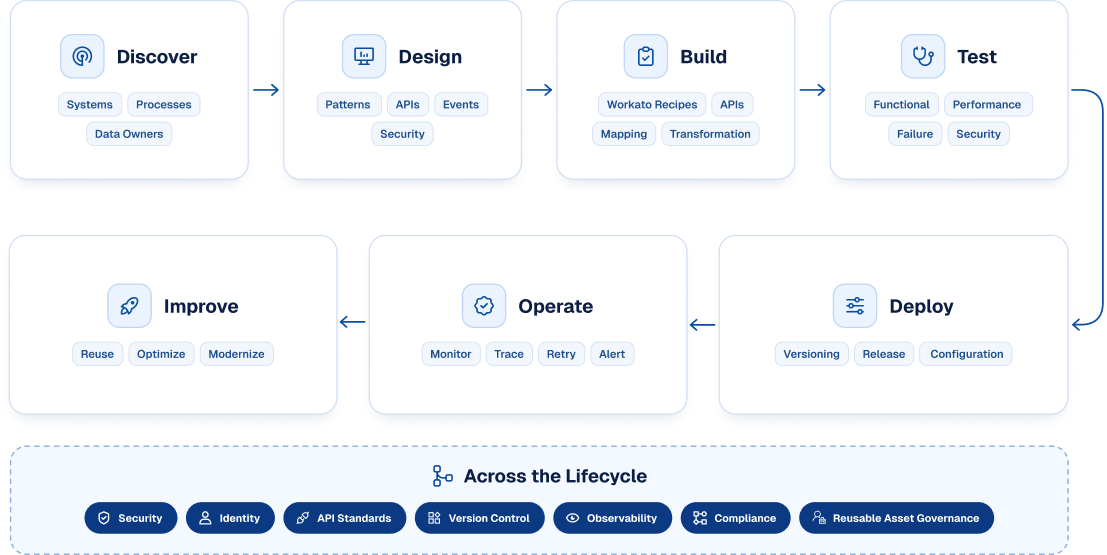
Reliable integration requires more than development. It needs architecture, governance, testing, monitoring, and continuous improvement throughout its lifecycle.
Why Choose KloudData as Your
Enterprise Application Integration Partner
The hardest integration decision is often not how to connect two systems, but how those systems should interact over time.
KloudData starts with the business process, data ownership, system responsibilities, and integration requirements before selecting the platform or technology.



Latest Application Integration Insights
Frequently Asked
Questions
What Do Enterprise Application Integration Services Include?
How Do You Integrate CRM and ERP Systems?
When Do Businesses Need Custom API Integration Services?
Can You Integrate Cloud, Legacy and On-Premise Applications?
What Integration Pattern Should We Use — API, Event or Batch?
Can KloudData Implement and Optimize Workato Integrations?
How Do You Monitor Enterprise Integrations After Go-Live?
Looking to Connect Your CRM, ERP and Business Applications?
Connect critical applications with secure, governed integration solutions designed for reliable data exchange, automated workflows, reusable connectivity, and scalable enterprise operations.
Discuss Your Integration Needs