

Enterprise AI adoption has reached an important turning point. Many organizations have already launched generative AI pilots, introduced workflow automation, or experimented with AI agents. However, turning these isolated initiatives into measurable, enterprise-wide business value remains a major challenge.
The problem is rarely access to AI technology.
The greater challenge is creating a structured enterprise AI transformation roadmap that connects business priorities, data, enterprise architecture, governance, employees, and measurable outcomes.
Without a clear AI implementation roadmap, organizations may end up with disconnected projects, duplicated technology investments, security risks, and AI pilots that never progress into production.
This guide explains how enterprise leaders can move from initial automation initiatives to an AI-driven organization by following a practical and scalable AI adoption framework.
What Is an Enterprise AI Transformation Roadmap?
An enterprise AI transformation roadmap is a phased plan that helps organizations assess AI readiness, identify valuable business opportunities, implement AI solutions, establish governance, and scale successful initiatives across the enterprise.
A well-defined enterprise AI roadmap helps business and technology leaders answer critical questions such as:
Experienced AI consulting services can help organizations answer these questions and create a roadmap based on business priorities instead of disconnected technology experiments.
Benefits of an Enterprise AI Transformation Roadmap
A structured AI transformation roadmap provides organizations with a stronger foundation for enterprise-wide AI adoption.
Key benefits include:
The objective is to transform AI from a collection of isolated experiments into a coordinated enterprise capability.
Why Enterprise AI Adoption Often Stalls
Many AI initiatives begin with technology rather than business problems.
A department may identify an AI platform, launch a pilot, and successfully demonstrate technical functionality. However, moving that solution into production introduces a different set of challenges.
Common barriers include:
An AI transformation roadmap creates a shared direction for technology teams, business leaders, data teams, security teams, and operational departments.
➥ Stage 1: Conduct an AI Readiness Assessment
Before launching additional AI projects, enterprises should evaluate their current capabilities and identify gaps.
An AI readiness assessment should examine areas such as:
This assessment creates a baseline for understanding where the organization stands today and what capabilities must be developed to support future AI adoption.
An AI maturity model can also help leadership teams evaluate progress across strategy, data, technology, governance, people, and operations.
➥ Stage 2: Identify High-Value AI Opportunities
Enterprise AI transformation should begin with business processes, not technology.
Organizations should identify workflows that are:
The first AI implementation should create measurable business value while also generating practical lessons that can support future projects.
➥ Stage 3: Define the Enterprise AI Architecture
AI solutions must operate effectively within the existing technology environment.
An enterprise AI architecture may connect:
Architecture decisions should support both immediate requirements and long-term AI adoption.
Without a shared architecture, enterprises may create disconnected AI solutions that eventually become expensive, complex, and difficult to manage.
Ready to Create Your Enterprise AI Transformation Plan?
Assess AI readiness, identify high-value AI use cases, define governance priorities, and create a practical path toward enterprise-wide AI adoption.
Download the Enterprise AI Roadmap➥ Stage 4: Build the First Production AI Solution
Once a high-value use case has been selected and the required architecture is defined, organizations can move from strategy into implementation.
A production AI solution may include:
Every implementation should have clear KPIs.
The objective is to demonstrate measurable business value, not simply technical capability.
➥ Stage 5: Establish Responsible AI Governance
As AI adoption increases across the organization, governance becomes increasingly important.
A responsible AI framework should address:
Governance should support enterprise AI adoption while maintaining appropriate operational and security controls.
Clear AI policies can also help reduce Shadow AI, where employees or departments use public or unauthorized AI tools without proper organizational oversight.
➥ Stage 6: Build an AI Center of Excellence
As AI adoption grows, enterprises may benefit from establishing an AI Center of Excellence, also known as an AI CoE.
An AI CoE can create shared standards across areas such as:
The purpose of an AI CoE is not to centralize every AI-related decision.
Instead, it provides shared expertise, standards, and guidance that help departments implement AI more consistently across the organization.
➥ Stage 7: Address AI Change Management
Technology alone cannot create enterprise transformation.
Employees must understand how AI will affect their responsibilities, business processes, and decision-making.
A strong AI change management strategy should include:
Employees should clearly understand where AI systems can operate independently, when human approval is required, and how exceptions should be handled.
Isolated AI Projects vs Enterprise AI Transformation
| Area | Isolated AI Projects | Enterprise AI Transformation |
|---|---|---|
| Strategy | Department-level initiatives | Organization-wide roadmap |
| Use Cases | Technology-driven | Business-value driven |
| Data | Project-specific access | Enterprise data strategy |
| Architecture | Point solutions | Shared enterprise AI architecture |
| Governance | Added after implementation | Defined from the beginning |
| Employees | Limited adoption planning | Structured AI change management |
| Measurement | Technical performance | Business KPIs and ROI |
| Scaling | Individual projects | Repeatable implementation model |
The difference is important.
Isolated projects focus on solving individual problems, while enterprise AI transformation creates a repeatable operating model for introducing, governing, measuring, and scaling AI across the organization.
➥ Stage 8: Scale AI Across Business Operations
Once the organization has demonstrated measurable value from initial AI implementations, successful patterns can be expanded across additional business areas.
Scaling may include:
AI scaling should be based on business results rather than simply increasing the number of AI projects.
A successful enterprise AI strategy focuses on repeatability, measurable outcomes, and operational impact.
➥ Stage 9: Build an Enterprise AI Operating Model
The final stage goes beyond automation.
An AI operating model defines how business teams, technology teams, data teams, AI agents, governance teams, and employees work together.
Within an AI-driven organization, AI systems may:
Employees continue to remain responsible for strategic decisions, exceptions, customer relationships, and high-impact activities.
AI becomes part of daily business operations rather than another standalone technology tool.
Common Mistakes to Avoid During Enterprise AI Transformation
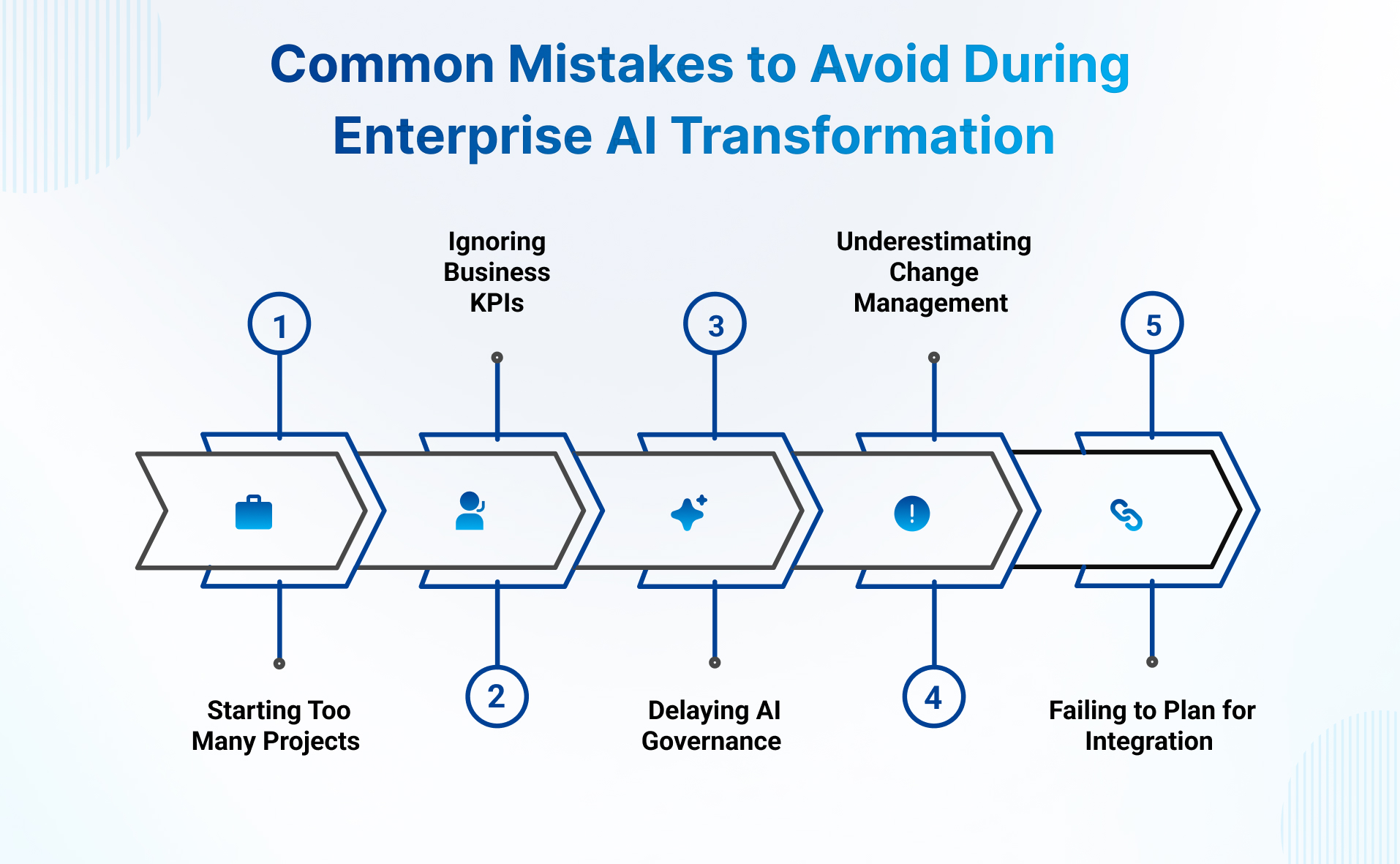
➥ Starting Too Many Projects
Launching multiple AI initiatives without a shared AI adoption framework can result in duplicated investments, inconsistent architecture, and integration problems.
Organizations should prioritize the strongest business opportunities and build repeatable implementation models before expanding.
➥ Ignoring Business KPIs
Technical performance alone does not demonstrate business value.
AI programs should be measured against clear business metrics such as cost, productivity, processing time, customer experience, revenue impact, or risk reduction.
➥ Delaying AI Governance
Security, responsible AI, privacy, and governance controls should be addressed before AI adoption expands across the enterprise.
Adding governance after deployment can create unnecessary risk and implementation challenges.
➥ Underestimating Change Management
Employees need proper communication, training, and defined processes for working with AI systems.
Without employee adoption, even technically successful AI solutions may fail to generate meaningful business value.
➥ Failing to Plan for Integration
Enterprise AI solutions must connect effectively with existing applications, enterprise data platforms, workflows, and operational systems.
Integration should therefore be considered during the planning and architecture stages rather than after development.
Why an AI-Native Approach Matters
Enterprise AI transformation is not simply about adding AI capabilities to existing software.
It requires organizations to rethink how data, enterprise systems, AI agents, workflows, employees, architecture, and governance work together.
As klouddata continues moving toward becoming a native AI company, our focus includes:
The objective is to help enterprises move from disconnected AI experiments toward an AI operating model that generates measurable and repeatable business value.
Key Takeaway
Enterprise AI transformation does not happen through isolated tools, experiments, or one-off technology projects.
It requires a structured AI transformation roadmap that begins with AI readiness, connects implementation with business value, establishes enterprise architecture and responsible AI governance, addresses employee adoption and change management, and creates repeatable methods for scaling successful initiatives.
Organizations that successfully progress from their first automation project to an AI-driven operating model will treat AI as an enterprise capability rather than a collection of individual technology projects.
Ready to Build Your Enterprise AI Transformation Roadmap?
Create a practical AI adoption framework that connects business priorities, enterprise data, architecture, governance, employees, and measurable outcomes.
Download the Enterprise AI RoadmapFAQs
What is an enterprise AI transformation roadmap?
An enterprise AI transformation roadmap is a phased plan that helps organizations assess AI readiness, identify high-value AI opportunities, implement solutions, establish governance, and scale AI adoption across the enterprise.
Where should enterprises start with AI adoption?
Organizations should begin with an AI readiness assessment and then identify high-value business processes with clearly defined problems, available data, and measurable success criteria.
What is an AI maturity model?
An AI maturity model helps organizations evaluate their existing capabilities across strategy, data, technology, governance, people, and operations. It can also help leaders identify areas that must improve before AI can scale successfully.
What is an AI Center of Excellence?
An AI Center of Excellence provides shared expertise, implementation standards, governance practices, architecture guidance, and support for enterprise AI initiatives.
Why is AI change management important?
AI change management helps employees understand how their roles, responsibilities, approval processes, and ways of working may change as AI becomes part of business operations.
How should companies measure enterprise AI transformation?
Organizations should track measurable business outcomes such as:
- Cost reduction
- Time savings
- Productivity improvements
- Faster processing
- Better customer experience
- Reduced operational risk
- Employee adoption
- AI ROI