

Enterprise AI adoption is accelerating across customer service, finance, healthcare, operations, supply chains, and internal business workflows.
AI agents are now accessing enterprise data, generating content, assisting with decisions, and performing actions across connected systems.
This creates significant opportunities for organizations, but it also introduces new risks.
Who controls what an AI agent can access? How are automated decisions reviewed? What happens when an AI system produces an incorrect response? Can every AI action be traced? And how should enterprises manage employee use of public AI tools?
These questions make AI governance a critical business and technology priority.
For enterprise IT, security, risk, and compliance leaders, responsible AI adoption requires more than written policies. Organizations need a practical AI governance framework that connects security, data, employees, AI models, business processes, and measurable accountability.
What Is AI Governance?
AI governance is the framework of policies, technical controls, processes, standards, and responsibilities used to manage how artificial intelligence is developed, deployed, monitored, and used across an organization.
A strong enterprise AI governance framework should address:
The goal of AI governance is not to slow down AI adoption.
It is to help organizations use AI responsibly while maintaining appropriate control over business operations, enterprise data, security, and risk.
Why Enterprise AI Governance Matters
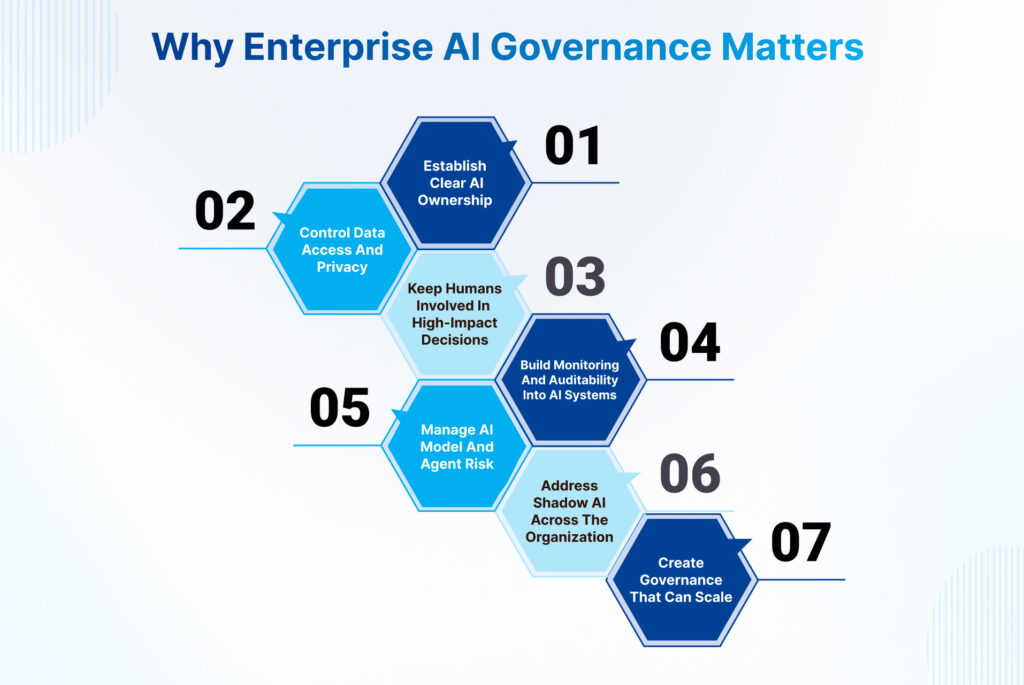
Traditional software usually operates through predefined rules and expected workflows.
AI systems work differently.
They can interpret information, generate responses, recommend actions, and support decisions based on changing data and context.
AI agents can go further by performing actions across CRM, ERP, finance, HR, customer service, and other enterprise applications.
Without a defined governance structure, organizations may face:
For this reason, enterprise AI security should be built into the implementation process rather than added after deployment.
➥ Establish Clear AI Ownership
Every enterprise AI system should have clearly defined ownership.
Organizations should identify who is responsible for:
AI governance becomes difficult when responsibility is spread across multiple departments without clear decision authority.
Defined ownership helps business, IT, security, legal, compliance, and data teams work within a shared operating model.
Each AI system should have accountable business and technical owners who understand both its purpose and its potential risk.
➥ Control Data Access and Privacy
AI systems should only access the information required to perform approved tasks.
Enterprises should implement controls such as:
Sensitive customer, employee, financial, healthcare, and operational information may require additional levels of control.
A responsible AI strategy begins with responsible data management.
Organizations should know what information an AI system can access, where that information comes from, how it is protected, and whether the AI system actually needs access to it.
➥ Keep Humans Involved in High-Impact Decisions
Not every business workflow should be fully automated.
Human-in-the-loop AI allows employees to review, approve, reject, or modify AI-supported decisions before they create significant business impact.
Human oversight is particularly important for workflows involving:
Organizations should clearly define which actions AI can complete independently and which actions require employee approval.
The level of human involvement should reflect the potential impact and risk of the AI system.
Is Your Enterprise Ready for Responsible AI Adoption?
Assess your current AI usage, data policies, security controls, governance gaps, and compliance requirements before expanding AI automation.
Get an AI Governance Assessment➥ Build Monitoring and Auditability into AI Systems
Enterprise leaders need visibility into how AI systems operate.
AI monitoring should help teams understand:
Audit logs support compliance reviews, investigations, operational improvement, incident analysis, and accountability.
AI systems that cannot record or trace their actions may create significant enterprise risk.
As AI systems become more autonomous, monitoring and auditability become even more important.
Organizations should be able to answer basic questions such as:
➥ Manage AI Model and Agent Risk
AI models can produce incorrect, inconsistent, or unexpected outputs.
AI agents introduce additional risk because they may perform actions across connected business systems.
Organizations should establish appropriate controls for:
The level of governance should reflect the potential impact of the AI system.
For example, a customer service assistant and an AI agent involved in financial approvals should not operate under identical controls.
Higher-risk AI systems require stronger monitoring, access restrictions, validation, escalation, and human oversight.
Traditional AI Adoption vs Governed Enterprise AI
| Governance Area | Unstructured AI Adoption | Governed Enterprise AI |
|---|---|---|
| AI Ownership | Unclear responsibility | Defined business and technical owners |
| Data Access | Broad or inconsistent | Role-based and controlled |
| Human Oversight | Limited | Defined approval and escalation processes |
| Monitoring | Basic usage tracking | Continuous performance and risk monitoring |
| Auditability | Limited records | Traceable AI actions and decisions |
| Security | Added after deployment | Included in architecture and implementation |
| Compliance | Reactive reviews | Ongoing governance processes |
| Scaling | Individual AI projects | Shared enterprise governance framework |
A governed approach creates consistency across AI initiatives and gives leadership greater confidence when expanding AI adoption.
➥ Address Shadow AI Across the Organization
Employees are increasingly using public AI tools to improve productivity and speed up everyday work.
Without clear policies, sensitive business information may be entered into unapproved systems.
Enterprises should create practical guidelines covering:
Simply blocking AI tools may not solve the problem. Employees may turn to other tools outside approved enterprise systems.
A stronger approach combines clear policies, approved enterprise AI solutions, employee education, and practical guidance.
The objective should be to give employees safe and approved ways to use AI rather than leaving them to determine acceptable usage independently.
➥ Create Governance That Can Scale
AI governance should not require organizations to create an entirely new approval process for every AI project.
Enterprises can establish shared standards for:
This creates a repeatable AI governance framework that supports enterprise AI adoption while maintaining appropriate controls.
A scalable governance model allows lower-risk AI initiatives to move efficiently while applying stronger review requirements to higher-risk systems.
This helps organizations maintain governance without creating unnecessary operational bottlenecks.
Why an AI-Native Approach Requires Strong Governance
As AI becomes part of everyday business operations, governance must become part of enterprise architecture.
AI-native organizations connect AI agents, enterprise data, applications, workflows, employees, security, and governance within a common operating model.
As Mobio Solutions continues moving toward becoming a native AI company, our focus includes:
The objective is to help enterprises implement AI systems that support business goals while maintaining security, accountability, appropriate controls, and human oversight.
Key Takeaway
Enterprise AI governance should not be viewed as a barrier to AI adoption.
A practical governance framework can help organizations use AI with greater security, accountability, compliance, and operational control.
The strongest approach connects data policies, enterprise AI security, human oversight, monitoring, compliance, risk management, and business ownership from the beginning.
As AI automation expands across business operations, enterprises that establish governance early will be better positioned to move AI initiatives from experimentation to responsible enterprise adoption.
Ready to Strengthen Your Enterprise AI Governance Strategy?
Identify security gaps, review AI risks, assess data controls, and create a practical governance framework for responsible AI automation.
Get an AI Governance AssessmentFAQs
What is AI governance?
AI governance is the framework of policies, processes, responsibilities, standards, and technical controls used to manage how AI systems are developed, deployed, monitored, and used within an organization.
Why is AI governance important for enterprises?
AI governance helps enterprises manage security, privacy, regulatory requirements, automated decisions, data access, operational risks, and accountability.
It provides organizations with a structured way to use AI while maintaining control over how systems access information and perform actions.
What is responsible AI?
Responsible AI refers to the development and use of AI systems with appropriate security, transparency, accountability, human oversight, and risk controls.
Responsible AI practices help organizations balance AI adoption with operational and business safeguards.
How does AI governance improve enterprise AI security?
AI governance establishes controls for:
- Data access
- Agent permissions
- Monitoring
- Audit logs
- System security
- Incident management
- Human escalation
These controls help enterprises understand how AI systems operate and reduce unauthorized or unmanaged activity.
What is human-in-the-loop AI?
Human-in-the-loop AI keeps employees involved in reviewing, approving, rejecting, or managing AI-supported decisions and exceptions.
It is especially useful where AI actions may have financial, legal, regulatory, healthcare, employee, or customer impact.
How should enterprises start building an AI governance framework?
Organizations can begin by:
- Identifying current AI usage
- Assigning business and technical ownership
- Classifying AI risks
- Reviewing data access
- Defining human oversight
- Establishing monitoring requirements
- Creating shared enterprise policies
The governance model can then evolve as enterprise AI adoption expands.