

Enterprise investment in AI automation continues to grow, yet many leadership teams still struggle to answer a fundamental question:
Is our AI investment creating measurable business value?
Tracking the number of AI tools, AI agents, pilots, or automated workflows does not provide the answer.
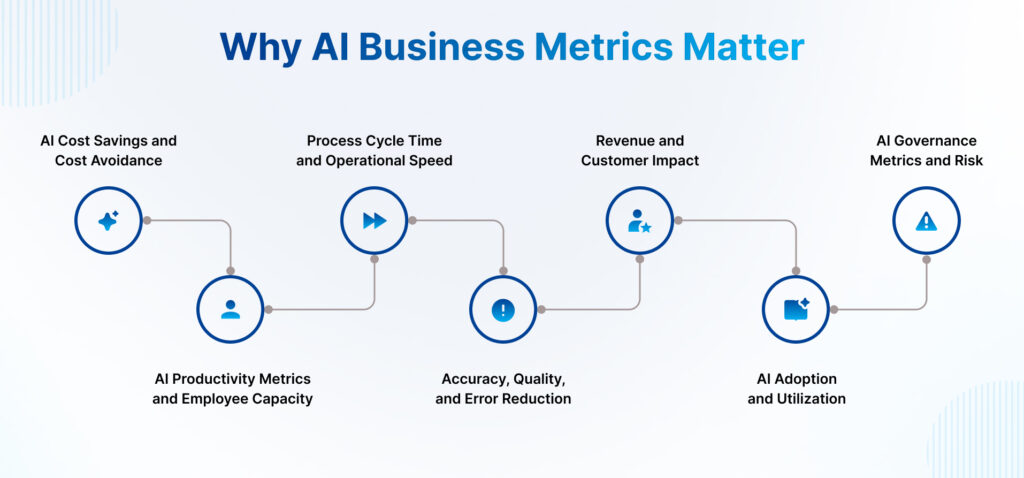
CXOs, COOs, CFOs, and other enterprise leaders need measurable outcomes connected to cost savings, productivity, speed, quality, revenue, adoption, and risk.
Without the right AI KPIs, organizations may continue investing in projects that perform well technically but deliver limited financial or operational results.
A clear measurement framework helps executives evaluate AI automation ROI, compare initiatives, strengthen the AI business case, and determine where future investment should be directed.
This guide explains the seven AI performance metrics every executive dashboard should track.
What Is AI Automation ROI?
AI automation ROI measures the financial and operational value created by an AI initiative compared with the total cost of implementing and operating it.
A basic ROI calculation is:
AI ROI = (Total Financial Benefit – Total AI Investment) ÷ Total AI Investment × 100
Total AI investment may include:
However, effective AI value measurement should not focus only on direct cost savings.
Executives should also evaluate whether AI improves:
A complete AI ROI measurement model combines financial, operational, adoption, and governance outcomes.
Why AI Business Metrics Matter
Traditional IT dashboards often focus on metrics such as:
These metrics remain useful, but they do not show the complete business impact of AI.
For example, an AI agent may achieve high technical accuracy but fail to reduce processing time.
An automated workflow may receive strong employee adoption but generate no measurable financial improvement.
This is why enterprise AI KPIs should connect technical performance with operational and financial outcomes.
Before implementation begins, leadership teams should establish:
Without a baseline, it becomes difficult to determine whether AI has actually improved business performance.
➥ AI Cost Savings and Cost Avoidance
Financial impact is one of the most direct AI implementation metrics.
Executives should measure:
Cost avoidance should be measured separately from direct savings.
For example, if AI automation enables an existing team to process 40% more work without adding headcount, the organization has created measurable business value even if current payroll costs remain unchanged.
A practical AI ROI calculator should therefore account for both direct cost savings and future costs that the organization was able to avoid.
➥ AI Productivity Metrics and Employee Capacity
AI automation should help employees spend less time on repetitive, manual activities.
Useful AI productivity metrics include:
Executives should avoid treating workforce reduction as the only measure of productivity improvement.
In many enterprise AI implementations, the greater value comes from helping existing teams manage higher business volumes.
Employees can then spend more time on:
AI productivity should therefore be measured by the additional capacity created, not simply by the number of roles reduced.
➥ Process Cycle Time and Operational Speed
Speed is another important indicator of AI automation ROI.
Organizations can compare business process performance before and after AI implementation.
Relevant metrics may include:
Reducing cycle time can improve operational capacity while also creating a better experience for customers and employees.
For executive reporting, the key question is:
How much faster is the business process operating because of AI?
Are Your AI Investments Delivering Measurable Business Value?
Compare AI costs, productivity, process performance, adoption, governance, and financial outcomes with a practical executive measurement framework.
Download the AI ROI Scorecard➥ Accuracy, Quality, and Error Reduction
Faster processes do not create meaningful business value if error rates increase.
Executive dashboards should track quality indicators such as:
Quality becomes particularly important for AI agents that perform actions across enterprise systems.
Executives should monitor both:
These AI performance metrics help leadership understand whether automation is genuinely improving business operations or simply increasing processing speed.
➥ Revenue and Customer Impact
Some AI initiatives create value primarily through revenue improvement rather than cost reduction.
Relevant AI business metrics may include:
For example, an AI voice agent that responds to customer inquiries outside normal business hours may capture opportunities that would otherwise have been missed.
However, this value should be connected to measurable outcomes.
Rather than stating that the AI agent created more opportunities, leadership should track metrics such as:
This creates a stronger and more defensible AI business case.
➥ AI Adoption and Utilization
An AI solution cannot create meaningful value if employees or customers do not use it
Executive dashboards should track:
Low adoption may indicate:
Adoption should therefore be evaluated together with financial and operational outcomes.
High usage does not automatically prove value, and high ROI is difficult to achieve when the intended users avoid the solution.
➥ AI Governance Metrics and Risk
AI success also requires operational control.
Executive dashboards should include AI governance metrics such as:
These metrics help leadership teams understand whether enterprise AI adoption is creating new operational, security, or compliance risks.
Strong AI performance combines measurable business value with:
An AI initiative that produces strong financial outcomes but creates unacceptable operational risk cannot be considered fully successful.
Traditional AI Adoption vs Governed Enterprise AI
| KPI Category | What to Track | Business Question |
|---|---|---|
| Financial Impact | Savings, cost avoidance, ROI | Is AI creating financial value? |
| Productivity | Hours saved, output per employee | Are teams managing more work? |
| Process Speed | Cycle time, response time | Are operations becoming faster? |
| Quality | Errors, rework, exceptions | Is automation improving accuracy? |
| Revenue | Conversion, retention, revenue impact | Is AI supporting business growth? |
| Adoption | Users, interactions, utilization | Are people using the solution? |
| Governance | Escalations, incidents, audit issues | Is AI operating within defined controls? |
This executive dashboard provides a balanced view of enterprise AI performance rather than focusing on a single financial or technical metric.
How to Build an AI ROI Measurement Framework
Organizations need more than a collection of dashboard metrics.
A practical AI ROI measurement framework should follow five steps.
➥ Establish Baseline Performance
Measure current costs, processing times, productivity, error rates, and other relevant outcomes before AI implementation.
This creates a benchmark for evaluating future improvements.
➥ Define Business Objectives
Identify exactly what the AI initiative is expected to improve.
Examples may include:
- Lower operating cost
- Faster response times
- Higher employee capacity
- Fewer errors
- Improved conversion
- Better customer experience
Clear objectives make it easier to choose meaningful KPIs.
➥ Calculate Total AI Costs
Include the full cost of the initiative, such as:
- Development
- Licensing
- Infrastructure
- Integration
- Training
- Maintenance
- Security
- Governance
Underestimating total costs can produce an inaccurate AI ROI calculation.
➥ Track Operational and Financial Outcomes
Measure actual performance against the established baseline.
Executives should review both financial results and operational improvements.
➥ Review and Improve
Use KPI data to:
- Improve the AI solution
- Expand successful initiatives
- Modify underperforming workflows
- Reconsider projects that fail to produce measurable value
The objective is continuous AI value measurement rather than a one-time ROI calculation.
How Often Should Executives Review AI KPIs?
AI performance should not be measured only at the end of a project.
A practical review model may include:
The exact frequency should depend on the importance, scale, business impact, and risk level of the AI system.
Higher-risk or mission-critical AI solutions may require more frequent operational monitoring.
For broader AI transformation ROI, executives should also review performance across multiple initiatives.
This helps leadership understand whether enterprise AI investment is generating organization-wide value rather than isolated project-level improvements.
Common Mistakes When Measuring AI Success
➥ Measuring Only AI Cost Savings
Cost savings are important, but they do not represent the complete value of AI.
AI may also create value through:
- Employee capacity
- Faster operations
- Improved quality
- Revenue growth
- Customer experience
- Risk reduction
➥ Tracking Too Many Metrics
More metrics do not automatically create better executive reporting.
Executive dashboards should focus on a limited set of KPIs directly connected to business outcomes.
➥ Ignoring Baseline Performance
Without pre-implementation data, it becomes difficult to quantify improvement.
Organizations should establish baseline metrics before the AI solution is deployed.
➥ Focusing Only on Technical Accuracy
AI model performance does not automatically translate into business value.
A technically accurate AI system may still fail to improve cost, speed, productivity, customer experience, or revenue.
➥ Failing to Track Total Costs
AI ROI calculations should include the complete cost of implementation and operation.
This may include:
- Development
- Software licensing
- Infrastructure
- Integration
- Maintenance
- Governance
- Security
- Employee training
Ignoring these costs can make ROI appear stronger than it actually is.
Why an AI-Native Approach Requires Better Measurement
As AI becomes part of everyday business operations, enterprises need a shared measurement model across:
An AI-native organization should be able to answer three important questions:
What business problem is AI solving?
What measurable value is it creating?
Should we improve, scale, or stop the initiative?
As klouddata continues moving toward becoming a native AI company, our focus includes:
- AI consulting
- AI agent development
- Workflow automation
- Enterprise integration
- AI governance
- AI value measurement
The objective is to help enterprises connect AI investments with measurable financial and operational results.
Key Takeaway
AI automation success should be measured by business outcomes, not by the number of AI projects launched.
Executive dashboards should connect AI investments with:
- Cost savings
- Productivity
- Process speed
- Quality
- Revenue
- Adoption
- Governance
The strongest AI ROI measurement strategy begins by establishing baseline performance, calculating the complete cost of AI implementation, and tracking financial and operational outcomes over time.
Organizations that define clear AI implementation metrics from the beginning will be better positioned to identify successful projects, improve underperforming initiatives, and make stronger decisions about future AI investments.
Ready to Measure the Real Business Value of AI Automation?
Create a clear framework for tracking AI cost savings, productivity, operational performance, adoption, governance, and enterprise AI ROI.
Download the AI ROI ScorecardFAQs
How do you measure AI automation ROI?
Measure AI automation ROI by comparing the financial and operational value created by the AI initiative with the total cost of development, implementation, integration, infrastructure, maintenance, training, security, and governance.
A complete measurement model should include both financial benefits and operational improvements.
What are the most important AI KPIs?
Important AI KPIs include:
- Cost savings
- Cost avoidance
- Productivity
- Process cycle time
- Quality
- Revenue impact
- Adoption
- Governance performance
The right combination depends on the specific business objective of the AI initiative.
What should an AI ROI calculator include?
An AI ROI calculator should include:
- Total implementation costs
- Ongoing operating costs
- Direct cost savings
- Cost avoidance
- Productivity gains
- Revenue impact
- Other measurable financial benefits
This creates a more complete picture of AI business value.
How long does it take to measure AI ROI?
The timeline depends on the use case.
Organizations should establish baseline metrics before implementation and then monitor performance continuously after deployment.
Some operational benefits may appear quickly, while revenue, customer, or enterprise transformation outcomes may require a longer measurement period.
Should AI success be measured only by cost savings?
No.
AI can also create measurable value through:
- Faster operations
- Higher employee capacity
- Better quality
- Revenue growth
- Improved customer experience
- Risk reduction
A strong AI measurement strategy captures all relevant business outcomes.
What should an executive AI dashboard include?
An executive AI dashboard should provide visibility into:
- Financial impact
- Productivity
- Process speed
- Quality
- Revenue
- Adoption
- Governance
These KPIs give leadership a balanced view of how AI is performing across financial, operational, and risk dimensions.