Observe AI in Production.
Improve Quality, Performance and Cost.
Our AI Observability Services give enterprises end-to-end visibility into AI applications, models, agents, retrieval workflows, quality, performance, usage, and operational cost — so teams can identify issues before they impact users or business operations.

AI Observability Services for
Reliable and Cost-Efficient AI Operations
Our AI Observability Consulting Services help enterprises instrument, monitor, evaluate, and optimize production AI systems across applications, RAG, agents, models, tools, infrastructure, and business workflows.

AI Observability Strategy & Instrumentation
Build telemetry, tracing, metrics, evaluation, and operational visibility into AI systems from the beginning rather than adding monitoring after production issues appear.

End-to-End AI & Agent Observability
Trace model calls, retrieval steps, agent decisions, tool usage, retries, and application workflows from user request through final business outcome.

RAG & Knowledge Retrieval Monitoring
Monitor retrieval quality, source usage, context relevance, latency, and retrieval failures so poor responses can be traced back to the knowledge layer when necessary.

AI Agent & Tool Call Observability
Track agent execution paths, tool calls, retries, handoffs, and task outcomes to identify failures, unnecessary complexity, and inefficient workflows.

AI Performance Optimization
Improve AI responsiveness and reliability by monitoring end-to-end latency, time to first response, model execution, tool execution, throughput, and capacity.

AI Cost & Unit Economics Management
Measure AI spend across models, applications, agents, workflows, teams, and business processes — then optimize cost per request, workflow, customer, or completed task without compromising required quality.
AI Regression & Release Evaluation
Compare model, prompt, retrieval, agent, and workflow changes against defined evaluation baselines before and after production release.

Complete Visibility Across
the AI Application Stack
Modern AI systems require visibility across the entire execution path, not only infrastructure health or individual model calls.
Application Layer Monitoring
Monitor user interactions, application workflows, failures, business-process outcomes, and overall task completion.
RAG & Knowledge Layer Monitoring
Track retrieval quality, source usage, context relevance, citation behavior, retrieval latency, and knowledge-source performance.
Agent & Workflow Monitoring
Understand agent paths, decisions, tool usage, retries, escalation, handoffs, and execution behavior across multi-step workflows.
Model Performance Monitoring
Track model usage, latency, response behavior, token consumption, version changes, reliability, and failure patterns.
Infrastructure & Capacity Monitoring
Monitor availability, quotas, throughput, errors, capacity, provider limits, and infrastructure conditions that can affect production AI performance.
Business Outcome Monitoring
Connect AI telemetry with task completion, workflow success, customer outcomes, and operational KPIs so teams can evaluate whether the AI system is creating business value.
AI Monitoring Solutions Built for
End-to-End Production Visibility
Our AI Monitoring Services provide visibility into AI behavior, quality, performance, reliability, security, and cost across production environments.
AI Request Tracing & Telemetry
Track AI execution across application logic, retrieval, agents, tools, models, and final responses using correlated traces and telemetry.
AI Quality & Reliability Monitoring
Measure application-specific quality signals such as correctness, groundedness, relevance, task success, failure rates, refusal behavior, and user feedback.
AI Cost Attribution & Budget Controls
Attribute spend by application, team, feature, customer, agent, or workflow, with budgets and usage thresholds to prevent unexpected cost growth.
Secure AI Telemetry & Data Controls
Manage how prompts, responses, tool inputs, retrieved context, and business data are captured, accessed, retained, and protected within observability systems.
Latency, Throughput & Capacity Monitoring
Measure end-to-end latency, time to first response, model and tool execution times, throughput, error rates, quotas, and production capacity.
Token, Model & Usage Tracking
Monitor model selection, token consumption, embedding usage, application usage, agent activity, and business-level AI consumption.
Anomaly Detection & Alerting
Detect unusual patterns in latency, quality, cost, usage, agent behavior, or failures and alert teams before they become wider production issues.
Standards-Based Observability Integration
Use standards-based telemetry and integrate AI observability with existing enterprise monitoring platforms rather than creating another isolated operational dashboard.
Balance AI Quality, Performance
and Cost in Production
Successful AI operations require visibility across four connected dimensions.
System Performance
Monitor:
- End-to-end latency
- Time to first response
- Throughput
- Errors
- Availability
- Capacity and quotas
AI Quality
Measure:
- Correctness
- Groundedness
- Relevance
- Task success
- Refusal quality
- User feedback
Usage & Cost
Track:
- Token consumption
- Model costs
- Embedding and retrieval costs
- Tool/API usage
- Cost per request
- Cost per workflow
- Cost per successful task
AI Behaviour
Understand:
- Agent execution paths
- Retrieval steps
- Tool calls
- Retries
- Guardrail events
- Prompt and model versions
- Human escalation
Optimize AI Cost Without
Losing Required Quality
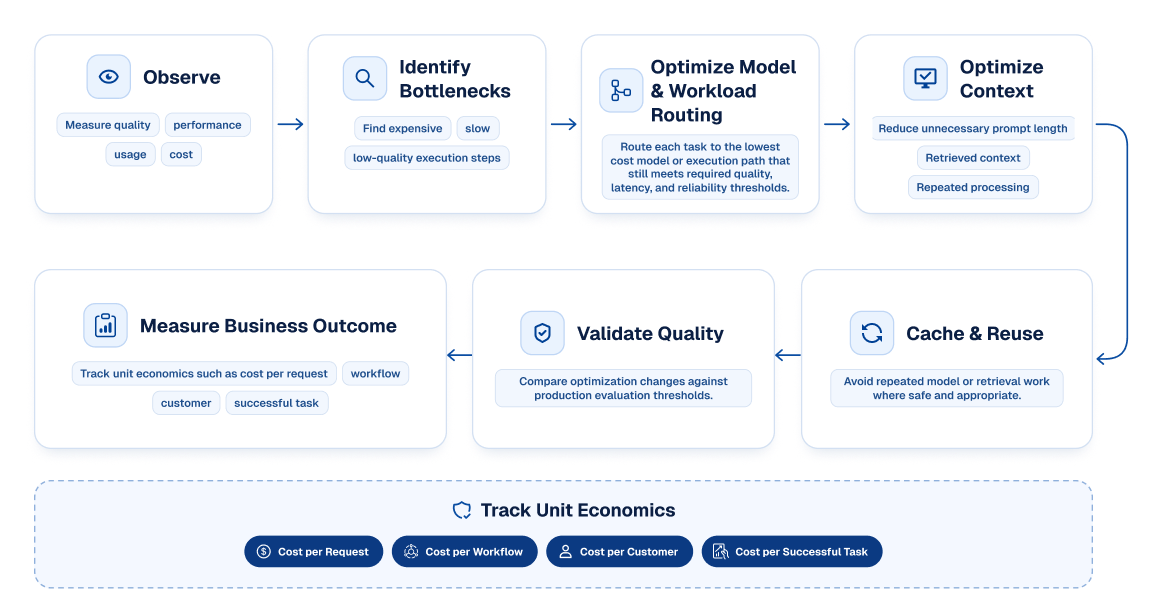
AI cost optimization should focus on the economics of the complete workflow — not token reduction alone.
Business Benefits of
AI Observability and Cost Optimization
Our AI Observability Services help organizations improve reliability, manage cost, reduce production risk, and scale AI operations with greater confidence.
Faster Root-Cause Analysis
Identify whether problems originate in application logic, retrieval, agents, tools, models, providers, or infrastructure instead of troubleshooting each layer separately.
More Reliable AI Experiences
Monitor quality, latency, task success, failures, and user-impacting behavior against defined production thresholds.
Lower AI Operating Costs
Identify expensive prompts, unnecessary model calls, oversized context, inefficient agent loops, and costly execution patterns before usage scales.
Better Cost Accountability
Track AI usage and spend across applications, teams, customers, agents, features, and business workflows.
Safer Production Changes
Evaluate model, prompt, retrieval, agent, and application changes against baselines before broad production rollout.
More Predictable AI Scaling
Monitor throughput, quotas, capacity, and cost trends so growing AI usage does not unexpectedly degrade performance or inflate operating expense.
Stronger AI Governance
Maintain auditable visibility into AI behavior, usage, quality, security events, releases, and operational incidents.
Continuously Improve
Production AI
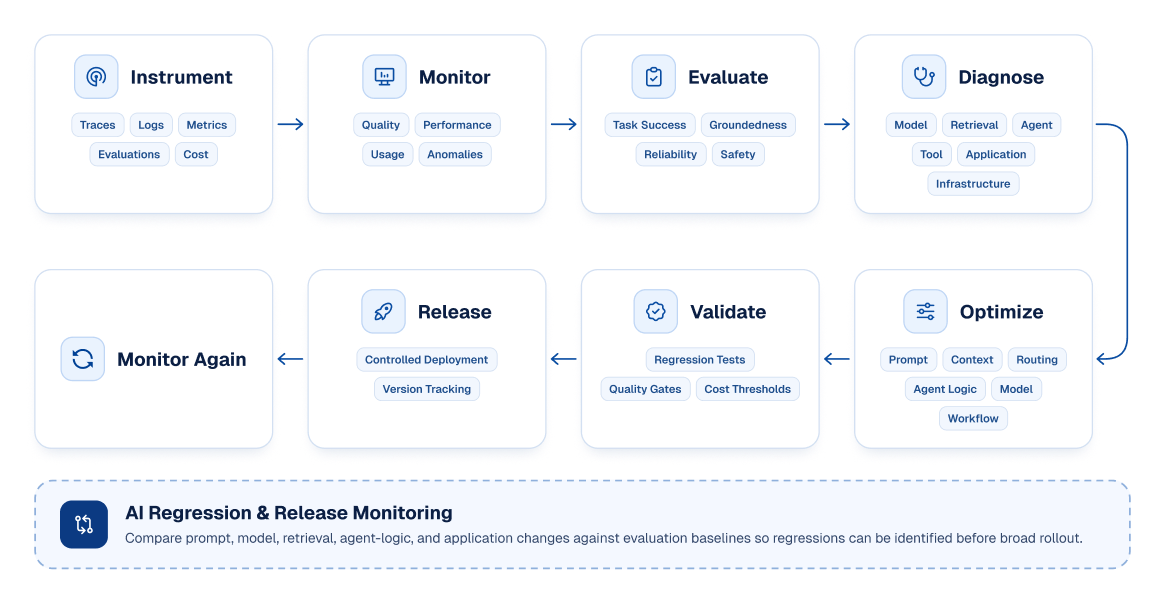
AI systems change as models, prompts, retrieval, data, traffic patterns, and business requirements evolve. KloudData uses closed-loop observability to continuously improve production AI.
Why Choose KloudData as Your
AI Observability Partner
Many production AI issues are difficult to resolve because teams cannot see which part of the system caused them — the application, retrieval layer, agent, tool, model, provider, or infrastructure.
KloudData connects AI telemetry with enterprise applications, data, and business workflows so teams can optimize not only model behavior, but the end-to-end outcome.


Latest AI Observability Insights
Frequently Asked Questions About
AI Observability Services
What Do AI Observability Services Include?
What Should Enterprises Monitor in Production AI Systems?
How Can LLM Performance and Costs Be Optimized?
How Is AI Observability Different From Traditional Application Monitoring?
How Do You Monitor AI Agents?
Can AI Telemetry Expose Sensitive Data?
How Do You Measure AI Quality in Production?
How Do You Prevent AI Cost From Growing Unexpectedly?
Ready to Improve AI Performance and Control Operating Costs?
Gain continuous visibility into AI quality, reliability, behavior, usage, and spend with AI Observability Services designed for production-scale enterprise AI.
Discuss Your AI Operations