Build Data Pipelines. Accelerate Trusted Insights.
Good decisions depend on data that is accurate, consistent, and available when it is needed. Well-designed ETL and ELT pipelines connect your data sources, handle the transformation work, and move trusted data into the platforms your business relies on for reporting and analytics.
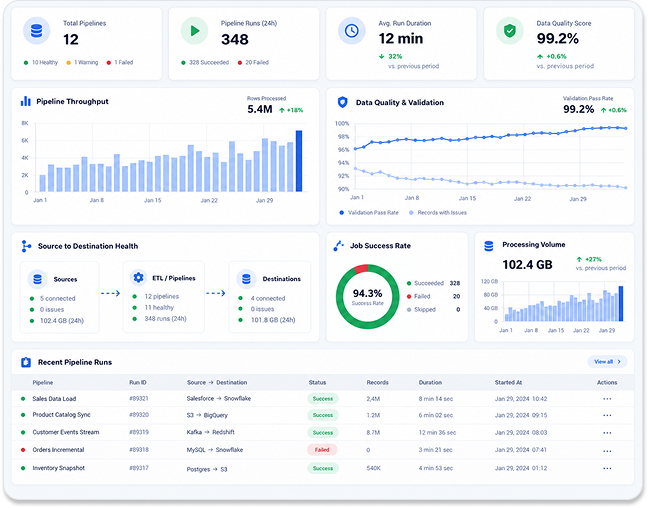
Enterprise ETL and ELT Development Services for
Scalable Data Processing
From data ingestion and transformation to orchestration and monitoring, ETL and ELT pipelines need to work reliably as data volumes, sources, and business requirements grow. A well-designed pipeline handles data quality, validation, error recovery, and dependencies along the way so downstream systems receive consistent, trusted data.

ETL & ELT Architecture Consulting
Select the right data processing approach based on workload requirements, source systems, and target platforms.

Custom ETL Pipeline Development
Develop pipelines for specific data sources, transformation requirements, and business rules.

ELT Pipeline Development
Load raw data into modern platforms first and apply transformations using scalable computing capabilities.

Data Transformation & Processing
Apply business logic consistently with structured, documented, and testable transformation workflows.

Pipeline Orchestration & Automation
Manage scheduling, dependencies, workflows, and recovery processes with automated orchestration.

ETL/ELT Optimization & Support
Improve pipeline performance, reliability, and scalability through continuous optimization.

ETL Pipeline Development Capabilities for Enterprise Data Workloads
Different workloads require different processing approaches. Pipeline design should align with data volume, speed requirements, and business objectives.
Batch Data Processing
Enable scheduled data movement at scale with validation and recovery capabilities.
Incremental Data Loading
Move only updated data to improve pipeline efficiency and processing speed.
Data Validation & Quality Controls
Implement quality checks within pipelines to improve downstream data reliability.
Real-Time & Streaming Pipelines
Process continuous data flows for use cases where faster insights are required.
Change Data Capture
Capture source system changes efficiently without requiring complete data reloads.
Pipeline Monitoring & Error Handling
Identify failures quickly with automated monitoring, alerts, and recovery processes.
Business Value Delivered Through
Reliable ETL and ELT Pipelines
Reliable pipelines reduce data delays, improve quality, and create a stronger foundation for analytics, reporting, and AI initiatives.
Faster Data Availability
Improve data access with automated pipelines. 76% of businesses make decisions without data due to access challenges.
Improved Data Quality
Improve reporting accuracy with validation controls. 87% of operations leaders identify poor data quality as a major challenge.
Reduced Manual Processing
Automate extraction, transformation, and loading workflows to reduce repetitive data tasks. 53% of data engineering time is spent maintaining pipelines.
Greater Pipeline Reliability
Build stable pipelines with monitoring and recovery. 30–47% higher failure rates are reported in legacy and manual pipeline approaches.
Faster Analytics & Reporting
Deliver trusted data faster for decisions. 71% of organizations spend significant time preparing data before analytics.
Scalable Data Processing
Create scalable data foundations for AI and analytics. 51% of organizations prioritize structured data before expanding digital initiatives.
Why Enterprises Choose KloudData for
ETL Development Services
Reliable data pipelines require strong engineering practices, platform expertise, and an understanding of enterprise data environments.



Latest ETL and ELT Insights
Frequently Asked Questions About
ETL and ELT Development Services
What Is the Difference Between ETL and ELT?
When Should an Enterprise Use ETL Instead of ELT?
Can Legacy ETL Pipelines Be Modernized?
How Is Data Quality Maintained Across ETL and ELT Pipelines?
How Do We Choose the Right ETL Development Partner?
Ready to Build Faster, More Reliable Enterprise Data Pipelines?
Build scalable ETL and ELT pipelines that deliver trusted data across analytics, reporting, and AI environments.
Discuss Your ETL & ELT Requirements